
Castles Open in Winter in Europe: What Shuts on 16 October, and What Gets Better
On Friday the Venus Grotto at Linderhof closes until 15 April, and Karlštejn's Chapel of the Holy Cross follows on 1 November. Not every castle shuts for winter, and some only shrink their hours. We read four opening calendars on 14 October.
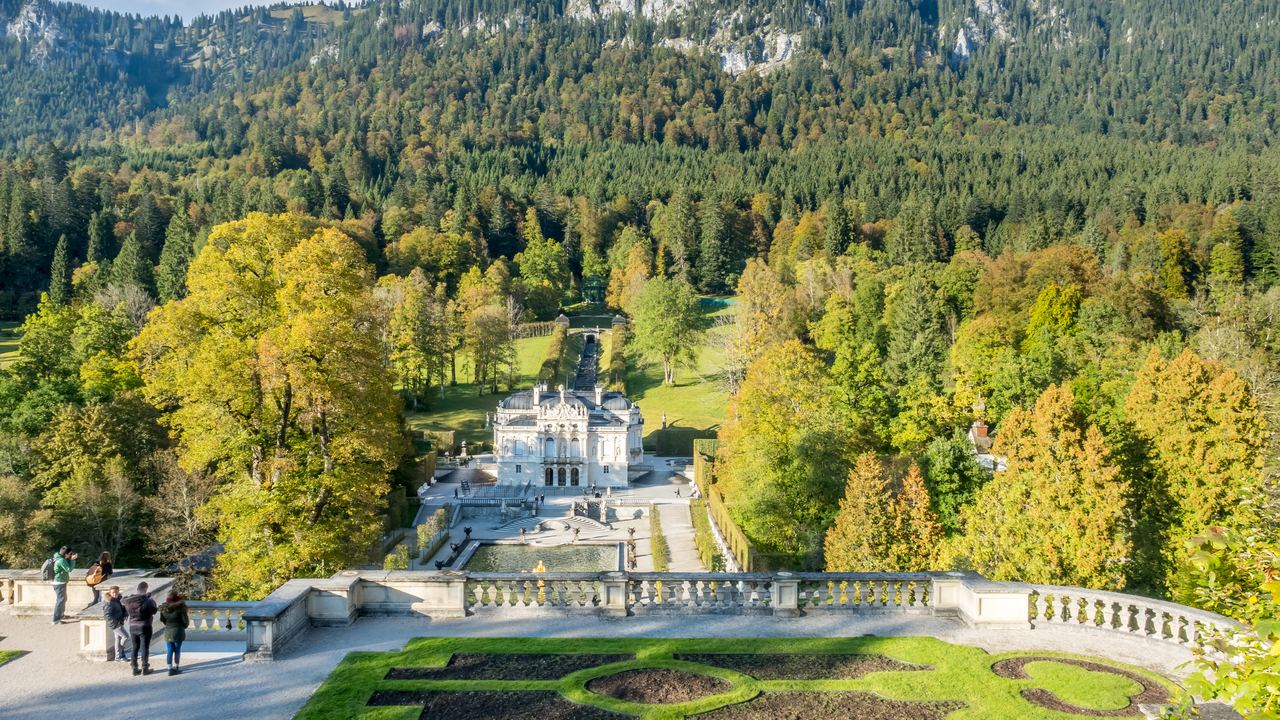
The list of castles open in winter in Europe is longer than most people expect, and the trap is not the castles that close. It is the ones that stay open with a door locked inside them. On Friday 16 October, two days after this was written, the Venus Grotto at Linderhof closes and does not reopen until 15 April. The palace a short walk away stays open every day of the year.
That gap is where a paid visit goes wrong. A monument that shuts for the season tells you plainly, and you book something else. A monument that keeps its gates open while its best room goes dark for six months tells you on a sub-page of its own site, in a table, under a heading about opening hours. We read those tables at four monuments in this catalogue this morning, and every date below comes from the body that owns the building, read on 14 October 2026.
What closes on 16 October, and what only shortens
Linderhof is the clearest case here because one ticket office sells four different calendars. The palace itself is open daily, all year, on two hour regimes: 9am to 6pm from 15 April to 15 October, then 10am to 4.30pm from 16 October to 14 April. Entry is by guided tour only, about 25 minutes, in German or English. Nothing about the visit changes in winter except that it is open for six and a half hours instead of nine.
Then the park starts closing. The Venus Grotto, the artificial stalactite cave Ludwig II had built as the Act I set of Wagner's Tannhäuser, runs 15 April to 15 October, daily 9am to 6pm, and the administration's own wording is closed 16 October to 14 April. The Moroccan House keeps the same calendar. Hunding's Hut and the Hermitage of Gurnemanz, the other two Wagner sets, open 11am to 6pm in season and close on the same day. The water features that make the parterre worth photographing run mid-April to mid-October, fountain every thirty minutes, and they stop too.
The opening/closing dates depend on the seasonal weather.
That sentence does more work than it looks. It means 15 April is a published date rather than a promise, in both directions, and it is the only honest way to write an opening calendar for buildings in an Alpine valley. Hardly anyone else in this vertical carries the caveat. Most pages print the season as though it were a train timetable.
One closure at Linderhof has nothing to do with the season. The Moorish Kiosk, bought from the Paris World Exhibition of 1867 and home of the Peacock Throne, is what a good many people make the detour for. The administration says it is undergoing extensive renovation and will remain closed until further notice, and offers a short film instead. Go in July and it is still shut.
| Monument, and which part | What happens | From | Back |
|---|---|---|---|
| Linderhof: Venus Grotto and Moroccan House | Closed | 16 October | 15 April |
| Linderhof: Hunding's Hut and Gurnemanz Hermitage | Closed | 16 October | 15 April |
| Linderhof: Royal Lodge exhibition | Drops to Sundays and public holidays, noon to 4.30pm, plus daily during the Bavarian school holidays | 16 October | 15 April |
| Linderhof: the palace itself | Stays open daily, 10am to 4.30pm instead of 9am to 6pm | 16 October | 15 April |
| Linderhof: Moorish Kiosk | Closed for renovation, until further notice | Not a seasonal date | Not announced |
| Karlštejn: Chapel of the Holy Cross, on the Chapels tour | Closed | 1 November | 1 May |
| Karlštejn: Imperial Residence, the basic tour | Drops from Tuesday to Sunday, 9.30am to 4.30pm, to Friday to Sunday, 10am to 3pm | 1 November | Table runs to 3 January, then stops |

What else stops on 16 October
The fountains keep the same calendar as the grotto
The water features at Linderhof run mid-April to mid-October, daily 9am to 6pm, with the fountain playing every thirty minutes. After that the parterre is still there and the jets are not.
It is a small thing, and it changes what a photograph looks like. It also sits on the administration's page rather than on the page that sold you the day trip.
Which castles are open in winter in Europe, and which only look it
Below is the same kind of information as a calendar rather than a list, and it is built on opening dates, not on weather. A grid like this usually tells you when a place is pleasant. This one tells you whether the door is unlocked, which is a different question and the one that costs money to get wrong.
Twelve months, four monuments, three states
Open, open on reduced hours, or closed. Built from the opening calendars the monuments publish, not from the climate.
| Month | 1 | 2 | 3 | 4 | 5 | 6 | 7 | 8 | 9 | 10 | 11 | 12 |
|---|---|---|---|---|---|---|---|---|---|---|---|---|
| Linderhof: the palace Open daily all year. 9am to 6pm to 15 October, then 10am to 4.30pm. Closed 1 January, Shrove Tuesday, and 24, 25 and 31 December. | 1 | 2 | 3 | 4 | 5 | 6 | 7 | 8 | 9 | 10 | 11 | 12 |
| Linderhof: the Venus Grotto Guided tour only, and only 15 April to 15 October. April and October are part months: it opens on the 15th and shuts on the 16th. | 1 | 2 | 3 | 4 | 5 | 6 | 7 | 8 | 9 | 10 | 11 | 12 |
| Karlštejn: Chapel of the Holy Cross The 640 CZK Chapels tour, sixteen people at a time. The castle's table shows it closed 1 November to 30 April, so 31 October is the last day. | 1 | 2 | 3 | 4 | 5 | 6 | 7 | 8 | 9 | 10 | 11 | 12 |
| Chenonceau Privately owned and open all 365 days of 2026. The hour it publishes is the last admission, not the closing time. | 1 | 2 | 3 | 4 | 5 | 6 | 7 | 8 | 9 | 10 | 11 | 12 |
| Castelo de São Jorge Open every day of the year but five. Until 9pm from March to October, and the earlier close is the only thing winter changes. | 1 | 2 | 3 | 4 | 5 | 6 | 7 | 8 | 9 | 10 | 11 | 12 |
Opening calendars read 14 October 2026: Linderhof and Karlštejn from the owning bodies, Chenonceau and São Jorge from this catalogue's monument records.
Two rows in that grid are the reason this piece exists. Chenonceau is privately owned, sits outside every French national pass, and is open all 365 days of 2026. Castelo de São Jorge is open every day of the year but five. Neither is a winter compromise. Both are simply open, and in January you get them to a degree August cannot offer.
The grid also cannot show the thing that catches the most people, because it is a weekday rather than a month. Peleș is closed on Mondays and Tuesdays, all year, which quietly deletes a third of the itineraries that include it. Belém Tower closes every Monday, and on 13 June. Bran is open every day of the year, but Mondays start at noon. A plan that is right about the month and wrong about the day of the week is still a wasted morning.

Karlštejn: one tour closes, the other shrinks to three days a week
Karlštejn sells three guided tours with three different rulebooks, and winter treats them differently. The Chapels tour at 640 CZK is the one with the Great Tower and the Chapel of the Holy Cross: sixteen people at a time, a hundred minutes, reservation required. Through October it runs Tuesday to Sunday, 10.05am to 4.05pm. The castle's own table then reads 1 November to 31 December: closed, and for 2027, 1 January to 30 April: closed. Saturday 31 October is the last chance until May.
The basic tour, the Imperial Residence of Charles IV at 300 CZK, never closes for the season, and that is precisely why it catches people. Until 31 October it runs Tuesday to Sunday, 9.30am to 4.30pm. From 1 November it runs Friday to Sunday, 10am to 3pm. Six open days a week become three, and seven hours become five. Anyone who checked the calendar in October and booked a Tuesday in November has booked a closed castle.
The exceptions are worth copying down, because they appear nowhere except the castle's own table. Monday 16 November and Tuesday 17 November are both open, 10am to 3pm, around the Czech public holiday. December runs Friday to Sunday until the 20th, then nothing from the 21st to the 25th, then every day from the 26th to the 31st. January 2027 opens Friday to Sunday.

Castles open in winter in Europe: the hour on the page is the last admission
This trap survives every season and gets worse in winter, when the margin is thinner. Karlštejn states it outright on its opening hours page: there are guided tours only, and the last tour starts at the same time like opening hours. Read that against the November line and the castle stops admitting at 3pm, which is when a reasonable person would assume they still had an hour in hand.
Chenonceau does the same thing in reverse. The hour it publishes is the last admission rather than the closing time, so the château is still letting people in when the number suggests it is turning them out. Linderhof prints both, and the distance between them is the useful part: from 16 October the palace is open 10am to 4.30pm and tickets are on sale 9.30am to 4pm, so the ticket window shuts half an hour before the building does. Under the summer regime the two pairs are 9am to 6pm and 8.30am to 5.30pm.
The clocks go back on 25 October, and the last tour goes with them
Across the European Union the summer-time period ends, in the words of the directive that sets it, at 1.00 a.m., Greenwich Mean Time, on the last Sunday in October. In 2026 the last Sunday in October is the 25th. It starts again at the same hour on the last Sunday in March, 28 March 2027. The United Kingdom keeps the same two dates.
What that does to a castle visit is arithmetic almost nobody does in advance. A tour at 4pm on Saturday 24 October is a tour at 4pm on Sunday the 25th as well, but the sun is an hour further on. The clock does not move the closing time. It moves the daylight out from behind it. For a monument whose interior is lit and whose courtyard is not, that is the difference between seeing the thing you came for and seeing its outline.
The dark arrives before the closing time
We calculate daylight rather than look it up, because astronomy does not go out of date. At the latitude of the Scottish Highlands, 57.48 degrees north, the sun sets at 15.31 in mid-December. Not dusk at 15.31: sunset. The Highlands run from 6 hours 38 minutes of daylight in December to 17 hours 59 in June, a ratio of 2.7 to 1. At Granada, 37.18 degrees north, the same ratio is 1.5 to 1, which is why a Spanish winter itinerary survives a late start and a Scottish one does not.
So the Highland problem in January is not that the castles are shut. It is that the useful part of the day ends before the published closing time, and the drive between any two of them eats most of what is left. Eilean Donan adds a constraint of its own: the trust sells tickets only on site, on the day, with no online box office, and no Scottish pass covers it. Arrive in the last hour of light in January and the gate is the only thing that can sell you anything.

Where the daylight runs out first
Sunset at 15.31, and tickets only at the gate
Mid-December at the latitude of the Highlands gives 6 hours 38 minutes between sunrise and sunset. Granada, on the same day, gives half again as much.
Eilean Donan has no online box office. The trust sells on site, on the day. In a short winter afternoon that turns the drive itself into the booking risk.
Nobody tells you it will be cold inside
Here is an absence we have checked across every monument in this catalogue: not one of them warns you about the cold. Unheated stone buildings, visited in January, on tours running twenty-five to a hundred minutes, and the warning appears on no official page. Exactly one monument warns about temperature at all, and it is the opposite warning. Buckingham Palace says of its State Rooms that it can become very hot inside, and its 81 open days in 2026 ran from 9 July to 27 September, so they are already behind us.
Which leaves the cold as the one piece of winter advice you will not get from the body that owns the castle. A hundred minutes at Karlštejn in November is spent largely on stairs and in rooms nobody heats, and the Chapels tour does not pause for anybody. Our page on what to bring and what they will not let in is the practical version, and it carries the published bag sizes, which matter more in winter when one of the things you are carrying is a coat.
What winter actually improves
The season has a real upside, and it is not the one the brochures claim. It is not that winter is romantic. It is that the capacity limits which define this vertical in August stop binding. Peleș releases 2,000 places a day in four bands and sells them out in summer; in a Romanian November the binding constraint is Monday and Tuesday, not the 2,000. Belém Tower admits 60 people at a time and 960 a day by its own regulation, and that number is the whole argument for going when nobody else is.
The trade is daylight and the occasional locked door, and it is a better trade for a palace than for a ruin. An interior does not care what the sky is doing; a curtain wall does. Linderhof is the extreme version: a villa finished in 1878, the only palace Ludwig II lived to complete, which puts it right at the end of the thousand-year story our twelve dates sets out. In February you can have its Rococo rooms inside six and a half hours of opening with barely a queue. You just cannot have the grotto.
One last thing about booking any of it. Winter is where the distance between the owner's page and the page selling it opens widest, because the closure only ever lives on the owner's page. Linderhof is the sharpest illustration in this catalogue: the gate ticket is €11, or €18 with the grotto, and the seventeen listings we track for it run to a median of €540.55, because eleven of them are private tours out of Munich. Whatever that premium buys, it does not buy a grotto that is open on 17 October. We set the same gap out at three other monuments when we compared gate prices with the pages above them last week. The rule for this season is short: find the owner's own calendar, read the part-month dates, and check the weekday as well as the month. Our page on tickets, time slots and selling out goes monument by monument.
Prague and Karlštejn, from the city
Karlštejn's basic tour drops to Friday, Saturday and Sunday from 1 November, and the Chapels tour closes until May. Check the day before booking a day out.
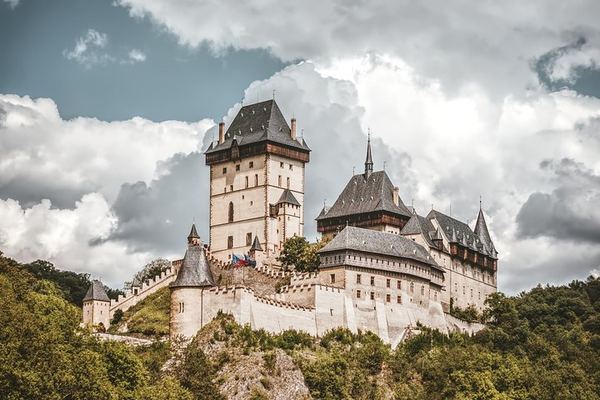
Charles IV Entered the Chapel Barefoot, and Rückl Has Blown Glass for 300 Years
A private day with lunch included, and a glassworks 30 minutes from the castle where one family has passed the craft down for three hundred years.
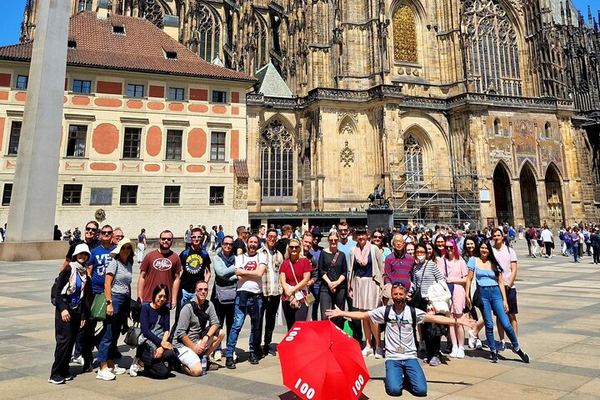
Eleven O'Clock for the Guard with Music, Afternoon for Kafka's House
Courtyards, gardens and exteriors only, no interiors: all four courtyards, the story of the Defenestration, and a red umbrella at Malostranská metro.
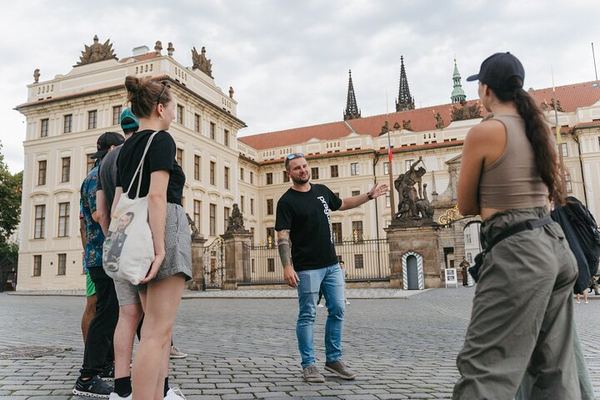
Founded About 920, Enlarged in 973: the Grounds, Not the Interiors
An afternoon walk through the courtyards and viewpoints, no tickets and no queues, entering by the side gate. The guide waits five minutes, no more.
Half a Day, Half an Hour Uphill, and All Sales Are Final Here
A half day by car with a private guide, a thirty-minute walk to the gates and an hour inside. The booking is final and no refund is given.
Ratings collected by Viator and Tripadvisor
Castles in winter: the questions people actually ask
Which castles are open in winter in Europe?
Of the monuments in this catalogue, these four were verified on their own pages on 14 October 2026. Chenonceau is open all 365 days of 2026. Castelo de São Jorge is open every day of the year but five, closing earlier than its 9pm summer time. Linderhof Palace is open daily all year, 10am to 4.30pm from 16 October to 14 April. Karlštejn's basic tour stays open through the winter but only Friday to Sunday from 1 November. The part to check is never the castle, it is which bits of it, and which days.
Is the Venus Grotto at Linderhof closed in winter?
Yes. The Bavarian Palace Administration publishes the Venus Grotto and the Moroccan House as open 15 April to 15 October, daily 9am to 6pm, and closed 16 October to 14 April. Hunding's Hut and the Gurnemanz Hermitage close on the same date. The grotto can only be seen on a guided tour, costs €9 on its own or €18 combined with the palace, and under-18s are admitted free. Separately, the Moorish Kiosk is closed for extensive renovation until further notice, in any season. The administration adds that its opening and closing dates depend on the seasonal weather.
Is Versailles open in winter?
The estate publishes a low-season calendar with shorter hours, but we are not printing times for it here: chateauversailles.fr would not open to us on 14 October 2026, and this site only publishes numbers it has read at the source. Check the estate's own calendar, and note the thing worth knowing about Versailles whatever the season, which is that the only queue-skip two travel forums agree on is the one the palace sells itself for about €10.
What is Neuschwanstein castle like in winter?
The visit itself does not change with the season: a thirty minute guided tour of fourteen rooms, at a time printed on the ticket, €21 plus a €2.50 booking fee, with under-18s free. What winter changes is everything around it. The state sells nothing at the castle, only same-day remainders at the Ticket Center in the village below, and the approach is 1.5km of constant and sometimes steep asphalt climb. Nobody is rescheduled for arriving late. Read the hours on the administration's own page for the date you are going.
What time do castles close in winter?
Earlier than in summer, and often earlier than the hour on the page. Karlštejn states that there are guided tours only and that the last tour starts at the same time as the closing hour, so its 3pm in November is the last admission. Chenonceau also publishes a last admission rather than a closing time. Linderhof publishes both, and from 16 October the palace is open 10am to 4.30pm while the ticket office sells 9.30am to 4pm. Where a monument gives only one number, assume it is the last admission.
When do the clocks change in Europe in 2026?
Summer time ends at 1.00am GMT on Sunday 25 October 2026, and begins again at the same hour on Sunday 28 March 2027. Those dates come from the directive itself, which fixes the change to the last Sunday in October and the last Sunday in March, and the United Kingdom follows the same two days. For a castle visit it matters because the closing time stays where it is while the daylight behind it moves an hour earlier.
Will it be cold inside a castle in winter?
Probably, and you will not be warned. Across the monuments in this catalogue, not one publishes a warning about cold interiors. The single temperature warning anywhere is Buckingham Palace telling visitors its State Rooms can become very hot inside, which applies to the 81 summer days the rooms are open rather than to winter. Dress for an unheated building you cannot leave halfway through, because a guided tour at Karlštejn or Linderhof goes at the guide's pace, not yours.
Data verified on . Opening calendars read 14 October 2026 on schloesser.bayern.de and hrad-karlstejn.cz. Clock change: Directive 2000/84/EC. Daylight: NOAA solar algorithm at 57.48N. Editorial Policy


